escaperx-favicon

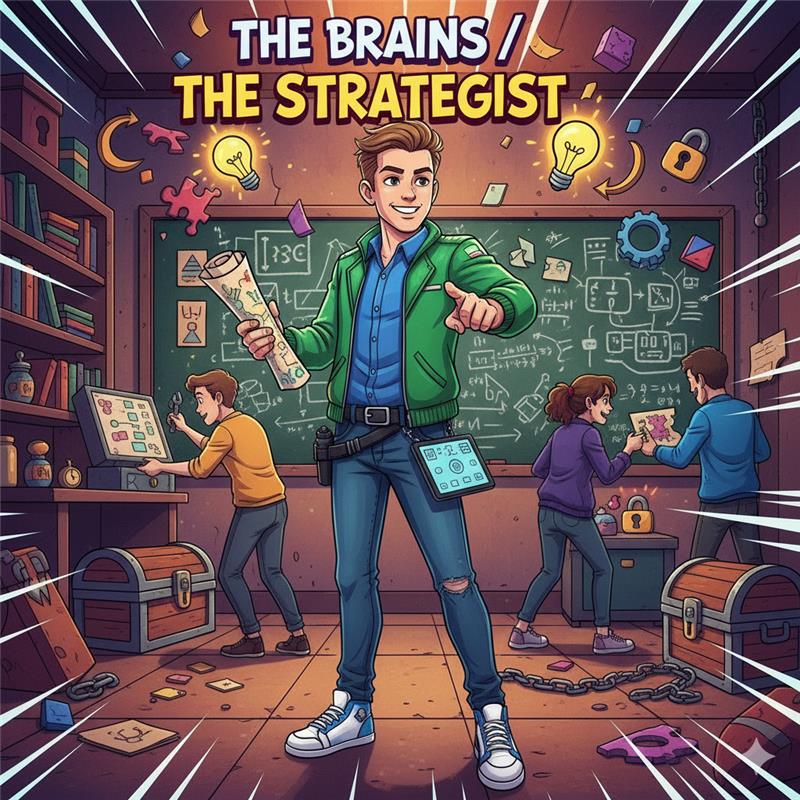
The Brains/The Strategist

Thinks several steps ahead, planning the team's next moves.

Escapers

members
2 Escapers USING THIS PERSONA
QR Code icon

Assign Persona Instantly

Scan the QR code to link and assign this persona seamlessly.
Quick, secure, and effortless your persona is just one scan away.

QR Code

๐Ÿ—บ ๏ธ Why Does a Team Need a Brains/The Strategist in Escape Rooms?

Every great escape room team needs energy, creativity, and quick thinking  but without direction, all that effort can scatter โšก. This is where the Brains, also known as the Strategist, comes in. They provide the guiding compass of the team ๐ŸŒช ๏ธ. Their role is not just about solving puzzles, but about keeping the entire team aligned, focused, and efficient.


Without a Strategist, teams often fall into common traps: multiple people working redundantly on the same puzzle, clues being overlooked, or time wasted chasing false leads ๐Ÿงฉ. The Strategist prevents this chaos by making sure everyone knows what to focus on, what’s been solved, and what’s left to tackle โœ….


They may not always be the loudest player in the room, but their influence is undeniable ๐Ÿ†. A good Strategist can turn a talented but disorganized group into a finely tuned machine capable of conquering even the trickiest rooms โš™ ๏ธ.

๐Ÿง  Who Is the Brains/The Strategist in Escape Rooms?

 They thrive on problem-solving, but what sets them apart from other players is their ability to see the big picture ๐ŸŒ.


While some players dive headfirst into puzzles, the Strategist pauses, observes, and evaluates. They ask ๐Ÿƒ‍โ™€ ๏ธ:

  • What do we already know? ๐Ÿ“–
  • What are we missing? โ“
  • โšก What’s the most efficient next step?

They may resemble natural leaders, but they don’t necessarily need to “command.” Instead, they influence through clarity and foresight ๐Ÿ”„. A Strategist knows when to let others run with an idea and when to step in to redirect focus ๐Ÿ—บ ๏ธ.


Key Traits of the Brains/The Strategist:

  • ๐Ÿง  Analytical: Breaks complex problems into manageable steps.
  • ๐ŸŒ Big-Picture Thinker: Keeps track of the overall progress.
  • ๐Ÿ”„ Adaptive: Willing to pivot strategies when new information emerges.
  • ๐Ÿ—ฃ ๏ธ Communicative: Ensures everyone understands the game plan.
Scholar deciphers future through archives.
Explorer decodes terrain through holograms.

๐Ÿ”‘ What Does the Brains/The Strategist Do in Escape Rooms?

The Strategist’s role extends beyond puzzle-solving it’s about shaping the team’s approach to the entire game ๐ŸŒ.

๐Ÿ‘€ Evaluates Situations

The Strategist is constantly scanning the room and assessing the team’s progress. Are people stuck? Is there a puzzle being neglected? Are we running low on time? They act like the team’s situational awareness system, making sure no clue or challenge slips through the cracks ๐Ÿ .

๐Ÿ“‹ Develops Strategies

Rather than leaving everything to chance, the Strategist creates plans. They may assign puzzles based on teammates’ strengths, or decide whether the team should split up or work together ๐ŸŽฒ. By setting a clear strategy, they prevent confusion and maximize efficiency.

๐Ÿ”ฎ Anticipates Challenges

The Brains think several steps ahead. If they see a locked chest with a three-digit code, they’re already cataloging possible clue sources before the team even finds the lock’s corresponding puzzle ๐Ÿ”ข.

๐Ÿ—ฃ ๏ธ Facilitates Communication

Escape rooms can get loud and chaotic. The Strategist acts as the communication hub, making sure discoveries are shared with the whole team ๐Ÿ“ข. A misplaced clue or an unsaid detail can cost a win  the Brains ensure nothing gets lost in translation.

๐Ÿ”„ Adjusts Plans as Needed

No strategy survives unchanged once the game begins. A good Strategist is flexible. They’re not married to one plan; instead, they adapt based on what the team discovers โšก. If a plan isn’t working, they pivot quickly and confidently.

๐ŸŒŸ When Does the Brains/The Strategist Shine in Escape Rooms?

The Strategist isn’t always in the spotlight, but their impact is most obvious in key moments ๐ŸŽญ:

  • ๐Ÿ Early Game (Setup Phase): When the room first begins, the Brains organizes the search ๐Ÿ—บ ๏ธ, assigning people to check specific areas so no spot is overlooked.
  • ๐Ÿ•ธ ๏ธ Mid-Game (Puzzle Web): As clues start connecting, the Strategist helps untangle the web, making sure the right people are on the right tasks ๐Ÿ‘ฅ.
  • โฐ Time Crunch (Final Minutes): With five minutes left, panic can set in. The Strategist keeps calm, directing focus to the most critical tasks and ensuring no time is wasted ๐Ÿ’จ.
  • โšก Sudden Discoveries: When a new clue changes everything, the Brains quickly reassesses and updates the plan, keeping momentum going ๐Ÿš€.
Elder commands light-born knowledge flow.
Touchscreen reveals time-bound enigmas.

๐ŸŒŸ Where Does the Brains/The Strategist Make the Biggest Impact?

The Strategist is especially vital in:

  • ๐Ÿง  Puzzle-Heavy Rooms: Where multiple puzzles must be solved in parallel, the Brains ensures tasks are divided logically.
  • ๐Ÿ“– Narrative-Driven Rooms: Where clues are interconnected, the Strategist tracks the story and prevents players from getting lost.
  • โšก High-Difficulty Rooms: Where small mistakes can cost the game, the Strategist’s oversight becomes invaluable.

๐Ÿงฉ How Can You Be a Better Brains/The Strategist in Escape Rooms?

๐Ÿง  Practice Critical Thinking

Engage in activities that sharpen analytical skills: Sudoku, chess, or logic puzzles ๐ŸŸฆ. These train your brain to break down problems efficiently.

๐ŸŽฒ Play Strategy Games

Board games like Pandemic, Codenames, or Risk improve your ability to plan ahead and manage resources skills directly transferable to escape rooms ๐Ÿ—‚ ๏ธ.

๐Ÿ—ฃ ๏ธ Work on Communication

A strategy is only as good as how well it’s shared. Practice giving clear, concise instructions and asking for updates without dominating conversations ๐Ÿ“ฃ.

๐Ÿ”„ Stay Flexible

Don’t fall in love with your first plan. Be ready to pivot quickly when the game shifts โค ๏ธ‍๐Ÿ”ฅ. Flexibility is as important as foresight.

๐Ÿ‘ฅ Learn Team Dynamics

Observe your teammates’ strengths. Some are great with riddles, others with physical puzzles ๐Ÿ’ก. Assign tasks accordingly.

๐Ÿง˜ Stay Calm Under Pressure

When the timer hits 2 minutes, teams often panic. Train yourself to stay calm your composure will anchor the rest of the group โฑ ๏ธ.

Final Thoughts: The Importance of Brains / The Strategist in Escape Rooms ๐Ÿง 

Every escape room team has its stars the Lock Keeper who triumphantly clicks open a padlock, the Clue Searcher who uncovers a hidden key, the Riddle Solver who cracks a clever word puzzle ๐Ÿ”Ž. Yet behind all these moments of progress, there is often one figure ensuring that the team’s efforts don’t scatter into chaos: the Brains, or Strategist โœ ๏ธ.


The Strategist’s role is subtle but indispensable ๐Ÿš€. They are not necessarily the fastest at solving puzzles or the boldest in taking action. Instead, their strength lies in how they think about the bigger picture how they coordinate, direct, and prioritize in a setting designed to confuse and overwhelm ๐Ÿ—บ ๏ธ. In many ways, the Strategist is the team’s compass, pointing everyone in the right direction even when time and pressure threaten to pull the group apart ๐Ÿงญ.


At the core of the Strategist’s persona is their ability to evaluate situations clearly. Escape rooms thrive on misdirection ๐Ÿ”: multiple puzzles vying for attention, scattered clues with unclear purposes, and time ticking relentlessly down. Without someone stepping back to assess what’s important and what can wait, teams often fall into the trap of tunnel vision. They focus on one puzzle for too long, duplicate each other’s efforts, or miss connections between clues. The Strategist combats this by maintaining awareness of the overall progress ๐ŸŽฏ. They know when to push forward, when to pivot, and when to distribute tasks differently.


This foresight is what transforms a group of individuals into a coordinated team ๐Ÿชข. A Strategist doesn’t just think for themselves they think for the collective. They are constantly asking ๐Ÿ‘ฅ: Who should work on this? How do these clues connect? Are we spending too much time here? What’s the next priority? These questions ensure that energy is channeled efficiently, reducing wasted time and maximizing the team’s strengths โžก ๏ธ.


One of the most powerful contributions of the Strategist is their ability to adapt. No plan survives the first puzzle, and escape rooms are notorious for throwing curveballs at players ๐Ÿ”„. What looked like a clear path may suddenly dead-end, or a puzzle thought to be simple may devour precious minutes. The Strategist thrives in these moments, adjusting priorities and reorganizing efforts so that the team doesn’t get bogged down ๐ŸŒ€. Their calm, flexible mindset prevents panic from spreading and keeps morale intact ๐Ÿ”ฅ.


Communication is another hallmark of the Strategist. While other players may get absorbed in their tasks, the Strategist is the one who ensures discoveries are shared and connections are made โš– ๏ธ. They act as a bridge between the Clue Searchers, Puzzle Solvers, and Lock Keepers, weaving everyone’s contributions into a coherent whole ๐Ÿง˜. A Strategist might not physically solve every puzzle, but their words “That code fits the lock we found earlier” or “Let’s save that clue for later” are often the sparks that ignite breakthroughs ๐Ÿ’ช.


Of course, being a Strategist comes with challenges. The pressure to “hold the plan together” can be intense, especially when the team hits roadblocks. It requires patience, humility, and the ability to lead without ego ๐ŸŒ. But when done well, the payoff is extraordinary: a smoother, more focused experience where everyone feels valued and the group achieves more than it could have alone ๐Ÿงฉ.


In many ways, the Strategist reflects a universal truth about escape rooms: they are not simply games of puzzles but games of people ๐Ÿ’ก. Success depends not only on intelligence but on how well individuals communicate, collaborate, and complement one another. And no persona embodies that truth more fully than the Brains ๐Ÿ™.


So, if you find yourself naturally drawn to planning, if you thrive on critical thinking, or if you instinctively step back to see the bigger picture, embrace the Strategist role ๐ŸŒ‰. Your presence may be the difference between a team that frantically stumbles through the room and one that confidently moves toward victory.

Users with this Persona

Explorer I

TAHA KHAN

The Brains/The Strategist

Rookie Escaper II

Sophia Robinson

Love this Persona? Make It Yours!

Do you see yourself in this persona?
Click below to add it to your profile and show the community who you are!

Claim This Persona

More Personas

The Peacekeeper

Calms tensions and resolves disagreements within the team.

The Anti Clues

Loves to go against the obvious, looking for unconventional solutions.

The Defeatist

Quickly gives up when things get difficult, doubting the teamโ€™s chances.

The Explorer

Ventures into every corner, always searching for new areas to investigate.

The Leaper

Takes bold risks, jumping into tasks without hesitation.

The Drag Along

Reluctantly participates but follows the team's lead when necessary.

Escaperx Agent